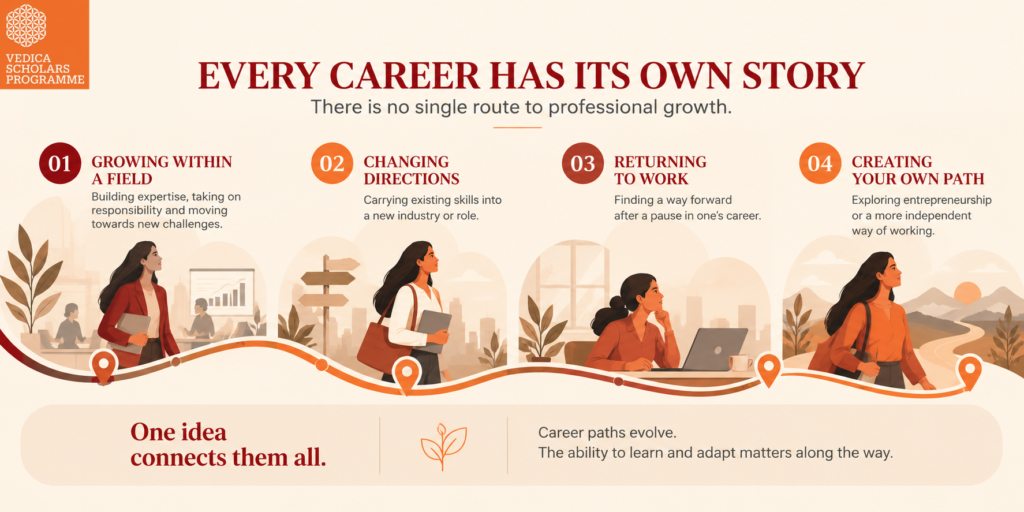
Most career maps look tidier in hindsight than they felt at the time. A first job leads to a second, a pause appears, a change of direction follows, and only later does a pattern emerge. This raises an important question: what does it mean to design a management programme for women around careers as they actually unfold, rather than around a single imagined route?
To explore how the Vedica Scholars Programme approaches this question, it helps to begin with the programme’s stated purpose and then consider how its approach to management learning and its features relate to different career paths. For prospective Scholars, this also offers a starting point for thinking about what to look for in a programme.
Building a Management Programme for Women Around Many Paths
Some careers develop within one organisation. Others cross sectors, involve a return to study, begin with a small venture or make room for responsibilities outside work. Ambitions differ too. For one person, success might mean reaching a senior position; for another, it could mean independence, meaningful work or greater flexibility.
Hypothetical example: Imagine two learners in the same classroom. One hopes to build a long career within a single organisation. The other expects to change sectors, take a break and eventually return to work. Their plans are different, but both need skills that can be applied to changing circumstances.
Treating all women as though they share the same ambitions would overlook these differences. A programme designed around varied career paths recognises that learners may want different things from their professional lives. The next question is how its learning and features support that broader approach.
What the Programme Says It Is For
The programme’s own account provides a starting point. Its Our Story page states that Anuradha Das Mathur co-founded Vedica to help women stay and thrive in the workforce. It also gives the credo as “Don’t quit on your potential” and describes a blend of business education, mentorship, liberal arts learning and personal growth to prepare women “not just for work, but for the long run”.
These statements explain the programme’s stated purpose and describe its approach. The page does not explain the reasoning behind every individual design decision, so it would be inaccurate to present an interpretation of those decisions as documented history. The following sections therefore distinguish between what the programme describes and how those features might relate to different career paths.
Why Management Learning Needs Real Situations
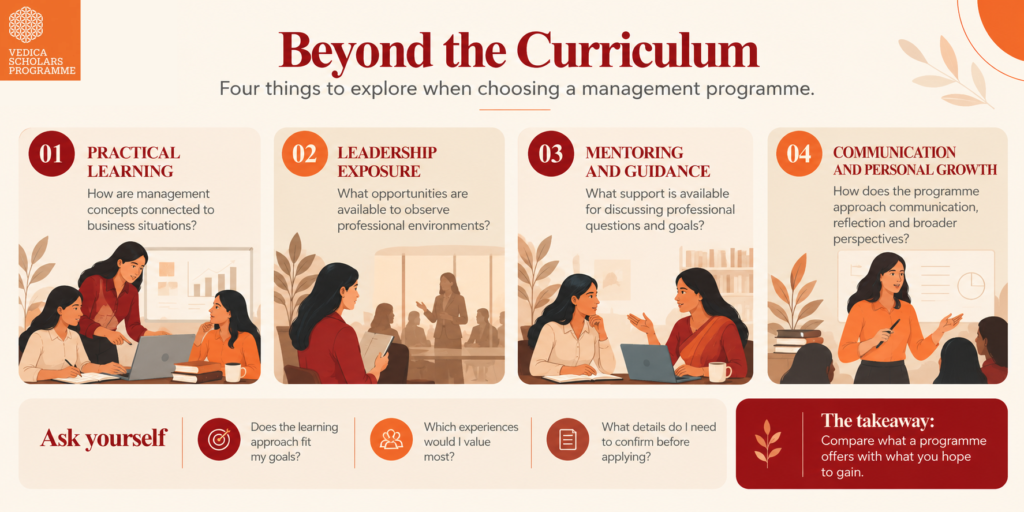
Management concepts become more useful when learners can apply them to practical situations. Understanding how a forecast is prepared, for example, is different from knowing when to question its assumptions. Many workplace decisions require both knowledge and judgement.
The programme’s Management Practice Track page describes its approach as practical management training, with concepts connected to real business challenges through live case discussions. It also lists Case Workshops, which use cases to help Scholars apply what they learn, and a Project Manager Series comprising simulation-based modules that draw on learning across courses.
The programme also lists three other tracks: Learning from the Liberal Arts, Thinking and Communicating for Impact, and Taking Charge of Personal Growth, alongside Mastering Management Practice. Together, these tracks cover more than the technical aspects of management. Communication, judgement and reflection can also influence how people approach decisions at work.
Where the Programme’s Features Meet a Career’s Questions
The Vedica Scholars Programme offers the Post Graduate Programme in Management Practice and Leadership. Beyond its learning tracks, several features may help prospective Scholars think about the kinds of experience and guidance they want from a programme.
- What does leadership look like up close? The Shadow a Woman Leader page describes a five-week module in which each Scholar is paired with an accomplished woman professional, attends meetings and contributes to projects. The page also states that more than 150 accomplished women across business, media, development, policy and entrepreneurship have mentored Scholars. This offers a way to observe professional environments beyond the classroom.
- Who can help me think through my choices? According to the Programme Mentors page, each Scholar is paired with a senior industry leader whose experience aligns with the Scholar’s goals and interests. Mentoring can provide an opportunity to discuss professional questions with someone who has relevant experience.
- How can I communicate my ideas effectively? The Thinking and Communicating for Impact page describes three abilities: Think, Express and Influence. It refers to interactive workshops, feedback sessions and real-world practice, as well as opportunities to observe communication during Shadow a Woman Leader. These experiences relate to a skill that matters across many roles: explaining ideas clearly to different audiences.
These descriptions outline what the programme says it offers. They do not establish how any individual Scholar’s career will develop, and no feature guarantees a particular outcome.
What Prospective Scholars Might Weigh
When comparing programmes, prospective applicants can look beyond the programme name and consider how its learning and support fit their own plans.
- How is learning applied, and how much of it involves practical work?
- Who will you learn from, and in what setting?
- Does the programme make room for different ambitions and career paths?
- What do the official programme pages say about its features, and what would you want to confirm directly?
These questions can help applicants compare what programmes offer with what they hope to gain from the experience.
Frequently Asked Questions
1. Who is the programme designed for, according to its own pages?
The homepage describes the programme as being for women who want to do more, lead with purpose and “chart their own career path”. Its stated focus provides context for prospective Scholars considering their next steps.
2. What does the Management Practice Track cover?
The programme’s Management Practice Track page names five areas: marketing and strategy, finance and accounting, operations and supply chain, economics and policy, and people and organisations. These areas relate to different aspects of how organisations operate and make decisions.
3. How can mentoring contribute to learning?
Mentoring can give learners an opportunity to discuss professional questions and hear another person’s perspective. The Programme Mentors page states that Scholars meet their mentors once a month, virtually or in person, to reflect, plan and consider their choices.
4. What does the liberal arts track add to management learning?
The programme’s homepage describes Learning from the Liberal Arts as a way to broaden the mind, deepen empathy and understand the world beyond business. Wider perspectives may help learners consider situations from more than one point of view. The description should be checked against the dedicated track page before publication.
5. How can I check what the programme offers before applying?
Start with the programme’s official pages and review the features relevant to your interests. If you have questions about the learning experience, mentoring arrangements or other details, contact the programme directly to confirm the current information.
Conclusion
Career paths rarely follow exactly the same route. A management programme for women cannot determine which direction a learner will take, but its learning approach and available experiences can give prospective Scholars useful factors to consider. Practical management learning, exposure to leadership and opportunities to discuss professional choices each offer a different perspective on career development.
The official pages describe what the Vedica Scholars Programme offers and the purpose it sets out to serve. They do not document every decision behind its design. For prospective Scholars, understanding those stated aims and examining the programme’s features is a useful starting point when deciding whether it aligns with their own ambitions.