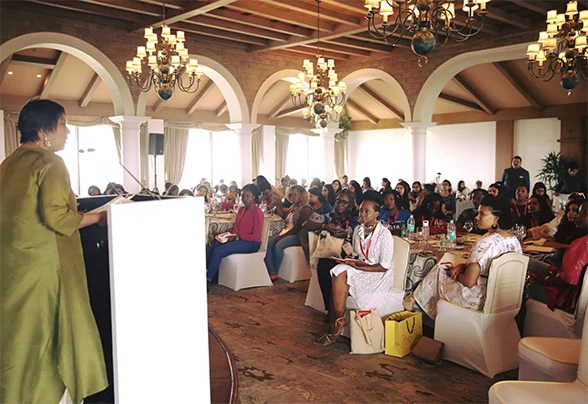
A leadership role rarely comes with an announcement. It arrives as a project nobody has claimed, a team that needs direction, or a decision that somebody has to make without a clear right answer. The person who steps forward is often already developing the judgement such moments call for. She may not realise it at the time. The Vedica Scholars Programme doesn’t leave that readiness to chance. The leadership programme for women rests on the idea that leadership develops gradually, through practice, exposure and reflection, rather than arriving with a title.
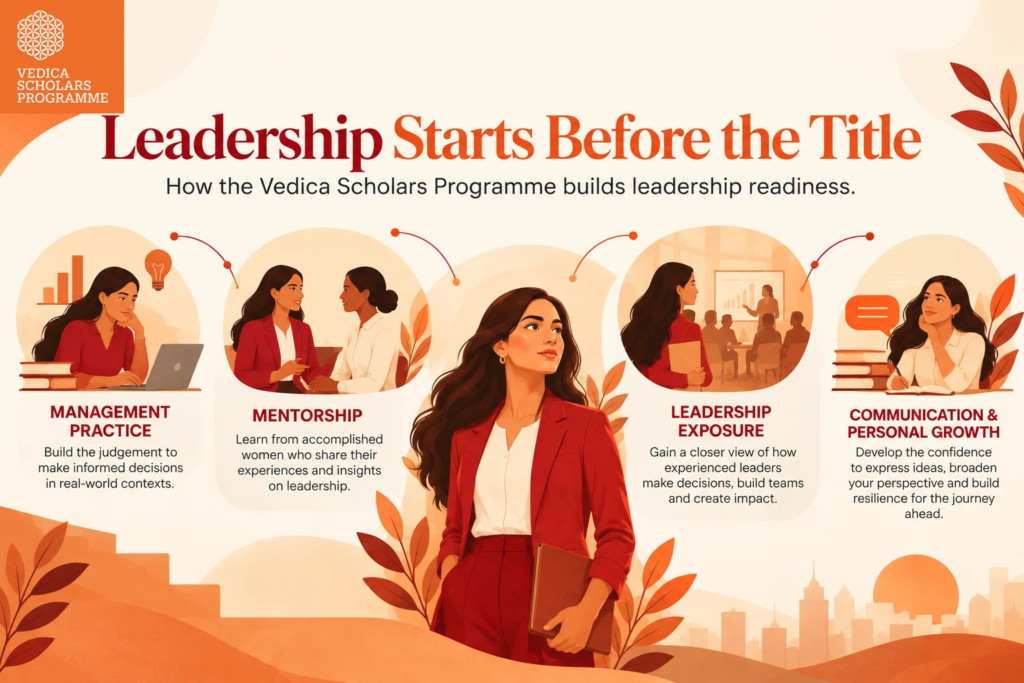
Why a Leadership Programme for Women Starts With Management
It’s easy to assume leadership begins once someone has a team to manage. In practice, people build the habits that shape good leadership well before that point: sound judgement, clear reasoning and the ability to decide with incomplete information.
The Mastering Management Practice track at the Vedica Scholars Programme covers:
- Strategy, finance and business planning
- Marketing, operations and organisational behaviour
- Business decision-making and problem-solving
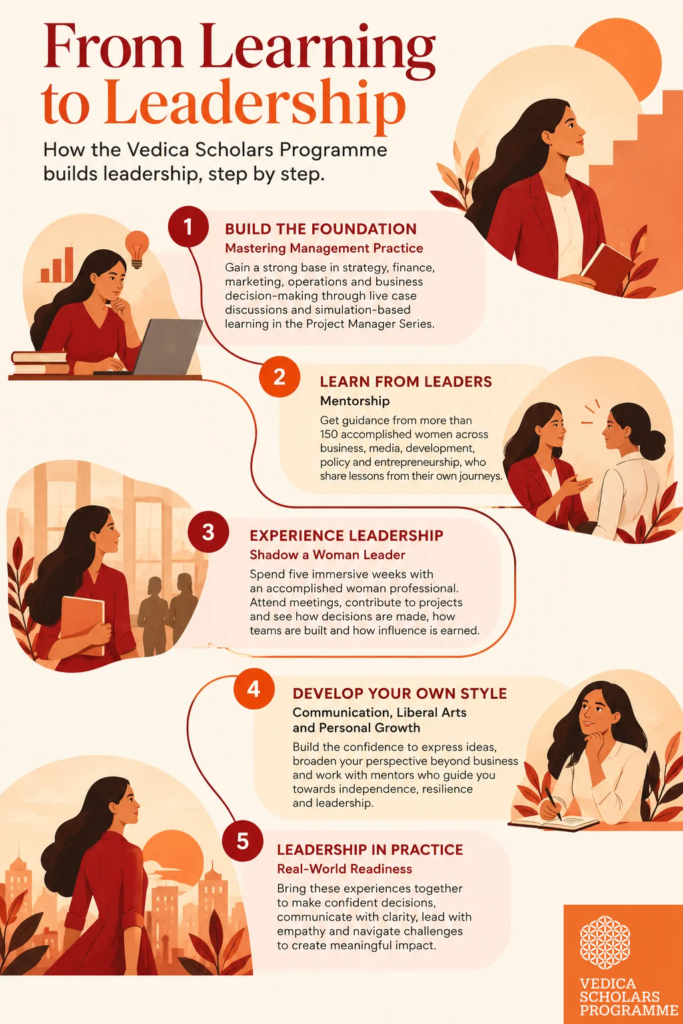
The programme doesn’t teach these subjects in isolation. Scholars work through live case discussions. They reason through a real business problem, defend their position and revise it when challenged. That is close to what leadership demands: making a call, explaining it clearly and being willing to rethink it if the situation changes. In addition, the Project Manager Series adds simulation-based modules in which Scholars apply learning from across their courses to realistic scenarios.
Mentorship That Shows Leadership in Practice
Reaching a decision is only the first part of leadership. A leader must also explain it, hold the team’s confidence and stay accountable if it doesn’t work out.
More than 150 accomplished women across business, media, development, policy and entrepreneurship have mentored Scholars at the Vedica Scholars Programme. They share lessons from their own journeys and show what leadership looks like when it rests on authenticity and impact and impact. For this reason, a classroom can’t fully replicate that kind of perspective.
Watching Leadership Before Practising It
In the Shadow a Woman Leader module, each Scholar spends five immersive weeks paired with an accomplished woman professional who has built and led with purpose. The mentors come from fields such as business, government, development, media and the arts. Scholars attend meetings, contribute to projects and see how leaders make decisions, build teams and earn influence.
Kirithiga Selladurai, Class of 2022, shadowed Sarah Dovlo, Head of Global Employer Branding and HR Marketing at Deutsche Telekom. In her words: “The experience made me realise I could be part of the room where decisions are made and add my voice to it.”
The module helps Scholars find their own leadership style through observation, dialogue and reflection, rather than imitate someone else’s.
Beyond Strategy: The Other Dimensions of Leadership
However, being right isn’t enough for a leader. She also needs to be understood, and she needs to understand the people her decisions affect.
The Thinking and Communicating for Impact track builds the confidence to express ideas and lead conversations that matter. That helps Scholars explain the reasoning behind a decision so a team can act on it. The Learning from the Liberal Arts track broadens how Scholars think about the world beyond business, deepening the empathy that shapes how a team experiences its leader.
The Taking Charge of Personal Growth pillar has Scholars work with mentors who guide them towards independence, resilience and leadership. That matters when a decision doesn’t land the way you hoped and you still have to take the next step calmly.
What This Builds Over Time
These experiences don’t revolve around a single promotion or milestone. Together, the experiences in this leadership programme for women build:
- The judgement to make a decision and stand behind it
- The ability to communicate a decision so a team understands it, not just receives it
- Direct exposure to real leadership, not just leadership theory
- The resilience to lead through setbacks as well as successes
- Professional relationships that can extend beyond the Vedica Scholars Programme
Frequently Asked Questions
1. Does the Vedica Scholars Programme prepare Scholars specifically for leadership roles?
Yes. Leadership preparation runs through the Post Graduate Programme in Management Practice and Leadership at the Vedica Scholars Programme, combining management practice, mentorship, the Shadow a Woman Leader module, communication and personal growth rather than a single standalone subject.
2. What role do mentors play in leadership preparation?
More than 150 accomplished women across business, media, development, policy and entrepreneurship have mentored Scholars, sharing lessons from their own leadership journeys.
3. Is the Shadow a Woman Leader module only about observation?
No. Over five weeks, Scholars attend meetings and contribute to projects alongside the woman leader they are paired with.
4. Does management knowledge alone make someone ready to lead?
Not entirely. The Vedica Scholars Programme pairs management practice with communication, liberal arts and personal growth, since leadership also depends on judgement, empathy and resilience.
5. What happens after the Shadow a Woman Leader module ends?
Many Scholars stay connected with their mentors as advisors, collaborators and friends, and some go on to work with their mentors’ organisations.
Conclusion
Each part of the Vedica Scholars Programme develops a different side of leadership. Management practice builds decision-making, and communication helps Scholars explain the reasoning behind their decisions. Mentorship and the Shadow a Woman Leader module give them a close view of how experienced leaders work. The liberal arts broaden perspective, and personal growth helps Scholars handle the outcome of difficult calls. In the end, leadership isn’t a separate subject here. It is what connects them all.