Leadership is often presented as the next step after learning how a business works. But the Vedica Scholars Programme approaches it more broadly. Its women leadership programme brings management education together with communication, liberal arts, personal growth, mentorship and experiential learning. Rather than treating leadership as a title or simply the ability to manage a team, the Programme focuses on the capabilities that help someone think, communicate, make decisions and work effectively with others.
The comparison with a typical MBA is therefore less about deciding which approach is better and more about understanding what the Vedica Scholars Programme deliberately places alongside management education.
Why a Women Leadership Programme Goes Beyond Business Knowledge
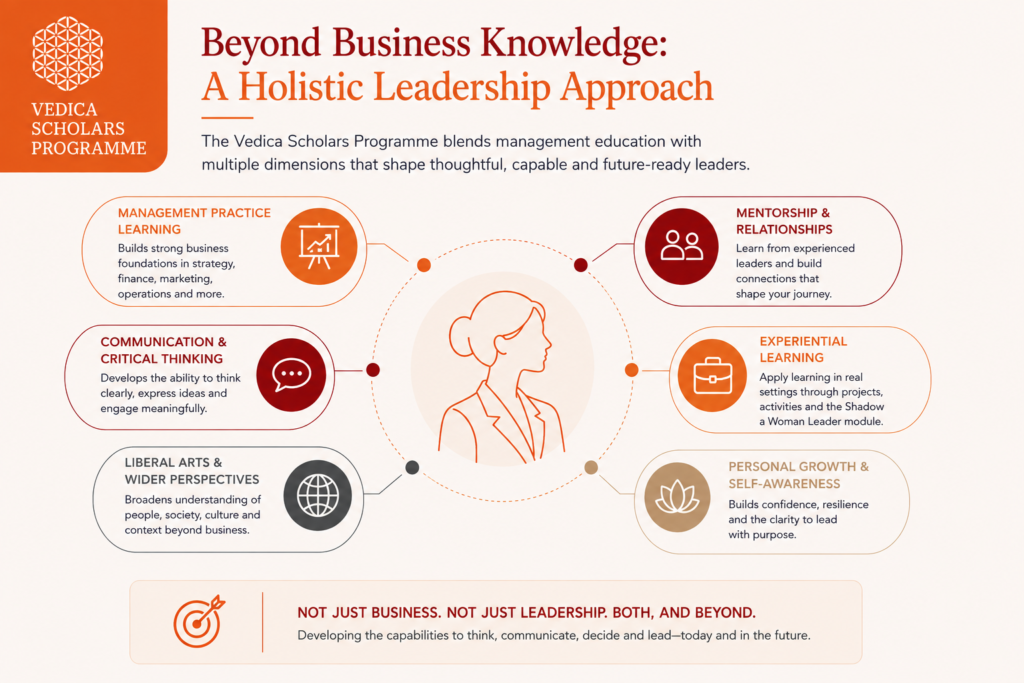
The Vedica Scholars Programme combines management and leadership learning with liberal arts, communication, mentorship and experiential learning. Its Management Practice learning covers areas such as strategy, finance, marketing, operations and decision-making, while other parts of the learning experience encourage Scholars to develop their communication, perspective and personal capabilities.
That broader combination matters because leadership rarely involves one skill at a time.
A professional may need to understand a business problem, consider different perspectives, communicate a decision and work with people to put that decision into practice. Management knowledge provides one part of that picture. Leadership requires the ability to bring those different capabilities together.
From Managing Tasks to Understanding People
A manager may need to understand financial performance, strategy or operations. A leader also needs to understand the people affected by those decisions.
This is why the Vedica Scholars Programme places attention on areas such as organisational behaviour, communication and personal growth alongside management learning.
The leadership development programme approach is therefore not limited to learning how to manage tasks or processes. It also asks Scholars to consider questions such as:
- How do people respond to change?
- How can difficult ideas be communicated clearly?
- What builds trust within a team?
- How should a leader respond when there is no straightforward answer?
The question becomes not only, “Can you make a good business decision?” but also, “Can you understand the context, communicate it effectively and bring people with you?”
Communication Is Part of Leadership
At the Vedica Scholars Programme, communication is not treated as something that comes after business knowledge.
The Thinking and Communicating for Impact track develops capabilities around critical thinking, writing, speaking and meaningful connection. These skills matter because even a strong strategy needs to be communicated, and even a difficult decision needs to be explained.
Consider a manager presenting a new direction to a team. Knowing the strategy is one thing. Explaining why it matters, listening to concerns and responding thoughtfully requires another set of capabilities.
This is where communication becomes part of leadership practice rather than simply an additional professional skill.
Liberal Arts Adds Another Lens
Another distinctive element of the Vedica Scholars Programme is the place given to liberal arts alongside management.
The purpose is not to move Scholars away from business. It is to broaden the way they understand the world in which businesses operate.
A management decision can involve questions about people, society, culture, behaviour and context. Not every organisational challenge can be understood through a financial model or management framework alone.
Iha Pravin, a Vedica Scholar from the Class of 2018, offers one example of what this broader thinking can look like in practice. She grew up in Ranchi and studied English Literature at St. Xavier’s College before finding the Vedica Scholars Programme, describing herself at the time as an “unsure, curious woman” with a dream of building a significant career. She has said that Vedica gave her a community of like-minded women, fuelled her generalist aptitude and taught her to look at both sides of every argument.
Her career has since moved through content and digital marketing, and she is now Chief of Staff at Western Digital. For a management programme for women, this wider perspective can help Scholars approach complex situations with more than one way of thinking, whatever direction their career eventually takes.
Iha’s experience also shows how that network can remain valuable beyond graduation. Eight years later, she describes the Vedica family as a network she still turns to whenever she needs help.
Leadership Is Experienced, Not Only Discussed
The Shadow a Woman Leader module is a clear example of this philosophy.
Over five immersive weeks, Scholars work alongside senior women leaders and gain first-hand exposure to leadership in professional settings. They can attend meetings, contribute to projects and observe how experienced professionals approach their work.
A discussion about decision-making can feel very different when a Scholar sees a leader weigh competing priorities in an actual workplace. A conversation about communication becomes more meaningful when she observes how a difficult discussion is handled in practice.
This is where experiential learning gives classroom concepts somewhere to land.
Developing Leadership Capabilities for the Long Term
The Vedica Scholars Programme treats leadership as something that develops over time rather than something achieved through a single position or skill.
Scholars build capabilities through a combination of:
- Management learning and practical business exposure
- Communication and critical thinking
- Liberal arts and broader perspectives
- Mentorship and professional relationships
- Personal growth and experiential learning
This combination is important because professional responsibilities change. The skills that help someone enter a workplace may not be the same skills they need when leading a team, managing uncertainty or taking on greater responsibility. The Vedica Scholars Programme takes a leadership skills programme approach that goes beyond preparing Scholars for a single role or position.
The aim, therefore, is not simply to prepare someone to manage a team. It is to develop the ability to keep learning, adapting and making thoughtful decisions as their career progresses.
Frequently Asked Questions
1. Is the Vedica Scholars Programme an MBA?
No. The Vedica Scholars Programme is a management and leadership programme that combines management education with liberal arts, communication, personal growth, mentorship and experiential learning. It should not be described as an MBA.
2. What does leadership mean at the Vedica Scholars Programme?
Leadership is approached through management capability, communication, personal development, judgement, mentorship and the ability to work effectively with people.
3. How does the Vedica Scholars Programme teach leadership practically?
Scholars gain practical exposure through management learning, case-based and experiential activities, mentorship and the Shadow a Woman Leader module. The latter gives Scholars first-hand exposure to senior women leaders in professional environments.
4. Why does the Vedica Scholars Programme include liberal arts?
Liberal arts can broaden how Scholars understand people, society and context, giving them perspectives that complement their management learning.
5. Is leadership only about managing people?
No. Leadership also involves communication, decision-making, critical thinking, adaptability, self-awareness and the ability to work effectively with others.
Conclusion
The difference in the Vedica Scholars Programme’s approach is not simply that leadership appears as another subject in the curriculum. It is woven through the wider learning experience.
Management helps Scholars understand how organisations work. Communication helps them express ideas and engage with others. Liberal arts broadens their perspective. Personal growth encourages self-awareness, while mentorship and experiential learning provide opportunities to see these capabilities in action.
That is how the Vedica Scholars Programme approaches leadership differently: not simply as a position to reach, but as a capability to keep developing throughout a professional life.